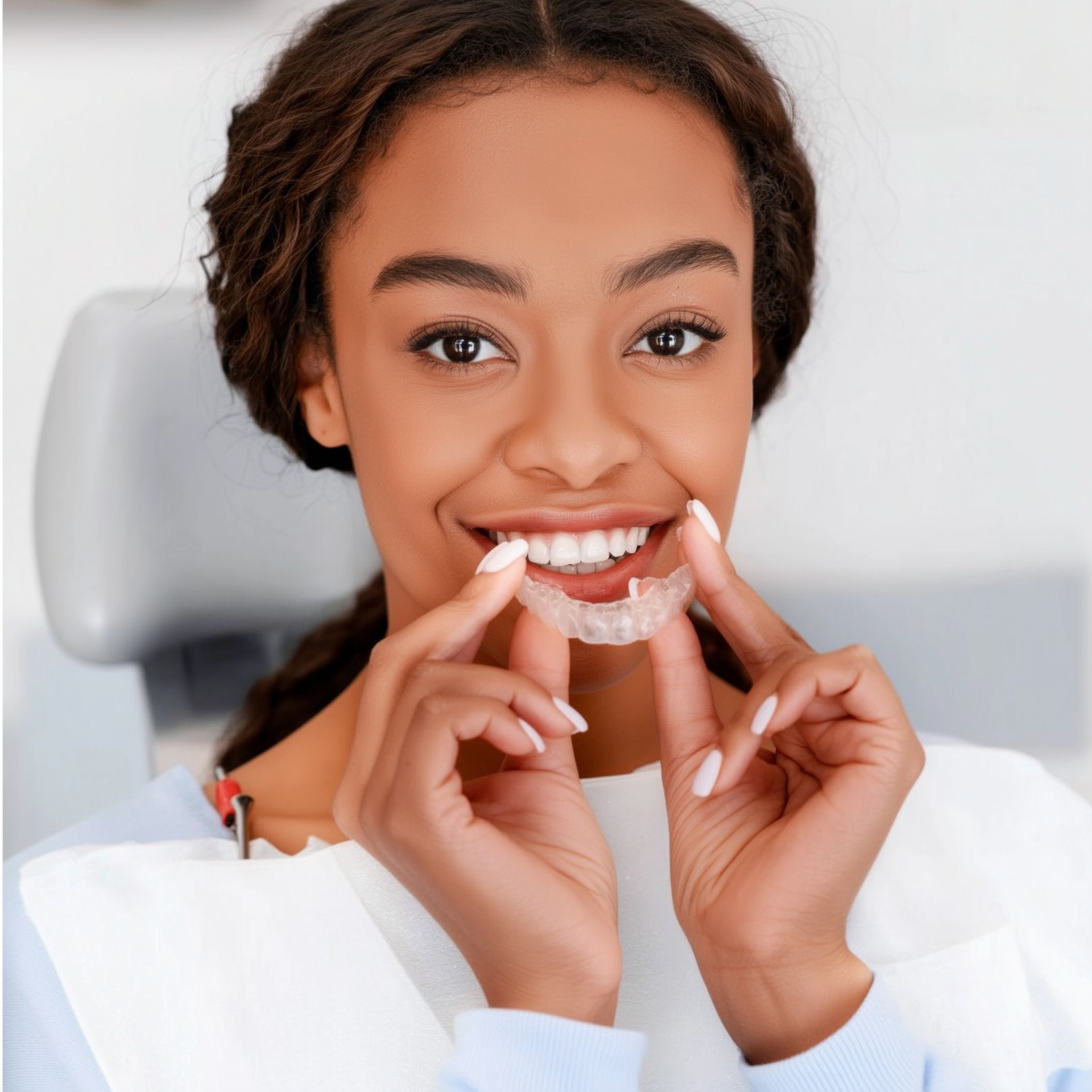
Brown Family Orthodontics explores how proper alignment supports oral health and everyday function.
QUICK ANSWER
Yes. Straight teeth are about more than appearance. At Brown Family Orthodontics in Greater New Orleans and on the Mississippi Gulf Coast, we straighten teeth to build a healthy bite, not only a nice photo. Teeth that are aligned and fit together properly are easier to brush and floss, spread chewing forces evenly instead of wearing a few teeth down, and keep protruding front teeth out of harm’s way. Some popular claims go further than the research supports, so this article also explains what a straight smile cannot promise.
KEY TAKEAWAYS
- Alignment and bite are two different things. Front teeth can look straight while the back teeth do not fit together, and bite problems are where most functional issues start.
- A 2026 meta-analysis in the Journal of Clinical Medicine found that children and teens with crowding and other bite problems had more plaque and more gum inflammation than peers with normal alignment.
- Upper front teeth that stick out more than 5 millimeters roughly double the odds of a chipped or knocked-out tooth in 12-year-olds, according to a 2019 Dental Traumatology meta-analysis.
- Research does not support the idea that a bad bite causes jaw joint disorders, so we never present orthodontics as a jaw pain cure.
- Wanting a smile you like is a legitimate reason to treat. A 2016 meta-analysis linked malocclusion with lower oral-health-related quality of life in children.
Your daughter’s school pictures came back, and her lips are pressed shut again. Your son chipped a front tooth on a water bottle at a rec league game in Chalmette. You noticed your own lower front teeth overlapping in a way they did not ten years ago.
Families often ask us the same question: “Is orthodontic treatment just cosmetic?” As a second-generation orthodontist and Diplomate of the American Board of Orthodontics, Dr. Jessica Brown Ulmer continues the legacy her father began, now practicing alongside her brother. Together, their family has treated more than 15,000 smiles across Louisiana and Mississippi, helping generations of patients understand that orthodontic care is about much more than appearance.
The short answer is no. The useful answer is more specific. Straight teeth do real work for your mouth, and they also get credit for a few things the evidence does not back up. We will tell you which is which.
What Does "Straight Teeth" Actually Mean to an Orthodontist?
To an orthodontist, straight teeth means three things working together: teeth lined up within each jaw, upper and lower teeth that fit together when you bite, and jaws that are the right size and position relative to each other. A smile can pass the first test and fail the other two.
The American Association of Orthodontists (AAO) describes teeth as gears that are made to fit together in a certain way. When they do not, the problem can be invisible from the front. We see this often with deep bites, where the upper front teeth cover the lower ones almost completely, and with crossbites, where some upper teeth sit inside the lower ones.
THREE THINGS WE EVALUATE
Alignment. How the teeth line up within each jaw, including crowding, spacing, and rotations.
Bite. How the upper and lower teeth meet, including overbite, overjet, open bite, and crossbite.
Jaw position. How the upper and lower jaws relate in size and position, which drives many bite problems in growing children.
Are Crooked or Crowded Teeth Harder to Keep Clean?
Yes. Crowded, overlapping, or rotated teeth create tight corners that a toothbrush and floss reach less well, and plaque that stays put is what irritates gums and feeds cavities. This is the best-supported oral health reason to straighten teeth.
A 2026 systematic review and meta-analysis in the Journal of Clinical Medicine(Szyszka-Sommerfeld and colleagues) pooled observational studies of children and adolescents and found that certain malocclusion traits were associated with more plaque and less favorable gum health indicators than normal alignment.
That matches what we see at hygiene checks. We often first notice bleeding around crowded lower front teeth, and those spots tend to improve once the teeth align and the patient can finally floss between them.
Two honest limits. The link between crowding and cavities is less consistent in the research than the link between crowding and gum inflammation, and a patient with excellent home care can keep crowded teeth healthy. Alignment makes good oral hygiene easier. It does not replace it.
CLEAN: Keeping crowded teeth healthy before and during treatment
- Angle the brush toward the gumline at about 45 degrees and spend extra time where teeth overlap.
- Use a floss threader or a water flosser for spots where regular floss will not slide through.
- Keep your six-month cleanings with your general dentist during orthodontic treatment, not only before and after.
Can a Bad Bite Wear Down or Chip Your Teeth?
It can. A bite that does not meet evenly concentrates chewing force on a few teeth instead of spreading it across all of them. Over years, those teeth can develop flattened edges, chips, notches at the gumline, and sensitivity.
The AAO lists added wear, chipping, and grinding as common problems with an improper bite. In our offices, uneven edge wear on the front teeth is something we point out at many first adult visits, and most patients had never noticed it.
The fix is rarely cosmetic bonding on the worn tooth alone. If the bite that wore it down is still there, the repair wears too. Correcting the bite first protects both the natural tooth and any dental work your dentist does afterward.
One limit worth stating: grinding, which dentists call bruxism, has many causes, including stress and sleep issues, and a corrected bite does not always stop it. A night guard may still be part of the plan after treatment.
Are Protruding Front Teeth More Likely to Get Hurt?
Yes, and the research is detailed on this one. Upper front teeth that stick out past the lower teeth, which orthodontists call increased overjet, sit outside the protection of the lip and take the hit when a face meets a ball, an elbow, or a sidewalk.
BY THE NUMBERS
1.8 times the odds of dental trauma for 12-year-olds with an overjet greater than 5 millimeters, and 3.4 times the odds for children age six and under with an overjet of 3 millimeters or more.
What it means: front teeth that stick out get chipped, loosened, or knocked out far more often than front teeth tucked behind the lip. The further out they sit, the higher the risk.
Source: Arraj, Rossi-Fedele, and Doğramacı, 2019, systematic review and meta-analysis in Dental Traumatology.
That matters in our communities. Between Friday night football across St. Bernard, Jefferson, and St. Tammany parishes, youth soccer and baseball seasons, and the ball fields near our Ocean Springs and Pascagoula offices in Jackson County, kids here spend a lot of time where they can get front teeth hit.
Dr. Jess treats many athletes and their families, and overjet is one of the first things we check on a young athlete.
Reducing a large overjet, sometimes with an early phase of treatment while a child is still growing, moves those teeth back under the protection of the lip. Until then, a properly fitted mouthguard is the best protection during sports.
PROTECT: Mouthguard basics for a child with protruding front teeth
- Wear one for any sport where a ball, a stick, or another player can reach the face, not only football.
- If your child is in braces, use a guard made for braces. A boil-and-bite guard molded over brackets can lock onto them.
- Expect the fit to change as teeth move. Bring the guard to appointments, and we will check it.
- Rinse it, dry it, and store it in a vented case. A damp guard in a gym bag grows things you do not want in a mouth.
Wondering whether your child’s front teeth stick out too far?
A free consultation at any of our seven offices includes a full bite evaluation, and we will tell you plainly whether early treatment, a mouthguard, or simply watching is the right call. Call 1-877-230-7841 or schedule here.
Does a Bad Bite Cause Jaw Pain or TMJ Disorders?
Not according to current evidence. The National Institute of Dental and Craniofacial Research (NIDCR) states that research does not support the belief that a bad bite or orthodontic treatment causes temporomandibular disorders (TMDs), the group of conditions that cause pain in the jaw joint and the muscles that move it.
You will read the opposite on many websites, including some orthodontic ones. We would rather be accurate. TMD appears to involve a mix of genetics, stress, and how a person processes pain, and the NIDCR notes that most cases improve with conservative care such as soft foods, heat, gentle stretching, and breaking clenching habits.
What orthodontics can do is make chewing more comfortable and even when a bite is clearly off. What it cannot do is promise to cure jaw pain. If jaw pain is your main concern, we will evaluate it honestly and may send you to a dentist or orofacial pain specialist rather than start braces.
Breathing is a related but separate question. The AAO notes that research suggests jaw size and position may play a role in some sleep breathing problems. Dr. Edward V. Brown III is a member of the American Academy of Dental Sleep Medicine, and if a child’s jaw position looks like it may affect breathing or sleep, that becomes a conversation with the child’s physician as well.
Can Tooth Alignment Affect Chewing and Speaking?
It can. A bite that does not meet evenly makes some foods harder to bite through, and an open bite, where the front teeth never touch, can make it hard to bite into a sandwich or to pronounce certain sounds clearly.
Chewing is the first step of digestion, and a comfortable bite lets you chew on both sides and break food down properly. We will not go as far as some articles and claim that straight teeth improve digestive health. We will say that a bite that works makes eating easier, and patients with a corrected open bite or crossbite usually notice that quickly.
Speech is similar. Tooth position affects sounds like "s" and "th," and closing large gaps or an open bite can help. Speech also depends on tongue habits, which is why some of our patients work with a speech therapist alongside orthodontics. Our post on harmful oral habits explains how thumb sucking and tongue thrusting create open bites in the first place.
Will Straightening Your Teeth Make Your Gums Healthier?
Straight teeth make healthy gums easier to achieve, but research has not shown that orthodontic treatment by itself prevents gum disease. Daily brushing and flossing, along with regular dental cleanings, remain the best ways to protect gums.
A 2008 systematic review in the Journal of Dental Education(Bollen) found that people with greater malocclusion tended to have more severe periodontal disease, but found no reliable evidence that orthodontic treatment improves periodontal health on its own. The author concluded that the findings do not justify recommending braces simply to prevent future gum problems.
So here is what we actually tell patients. If crowding makes it hard to floss, aligning the teeth removes that obstacle. If your gums are already inflamed, we want your dentist or a periodontist to get them healthy before we move teeth, because moving teeth through inflamed gums is not safe. Alignment and hygiene work together, and neither does the other’s job.
What If Appearance Is Your Main Reason?
Then that is a good enough reason. Wanting to smile without covering your mouth is not vanity, and research supports it. A 2016 meta-analysis of 40 studies in Clinical Oral Investigations(Kragt and colleagues) found that children with malocclusion were 1.74 times more likely to report a negative impact on their oral-health-related quality of life than children without.
We see it in our offices every week. The teenager who stops hiding behind a hand in photos. The adult who finally smiles in a work headshot. Those are real outcomes, and a straight smile earns them even when the bite was never a medical problem.
Our job is to make sure that when you come in for appearance, we also check function, so you leave with both. Braces, Invisalign, and Spark Clear Aligners can all correct bite problems as well as alignment when an orthodontist plans the treatment.
Here is how the three options compare on the functional goals in this article. The right choice depends on your bite, your age, and how reliably you can wear a removable appliance.
| Goal | Braces | Invisalign | Spark Clear Aligners |
|---|---|---|---|
| Align crowded or rotated teeth | Yes | Yes | Yes |
| Correct bite problems (overjet, crossbite, deep bite) | Yes, including complex cases | Yes, often with attachments and elastics | Yes, often with attachments and elastics |
| Depends on daily wear | No, fixed in place | Yes, 20 to 22 hours a day | Yes, at least 22 hours a day |
| Cleaning during treatment | Brush around brackets and wires | Remove to brush and floss normally | Remove to brush and floss normally |
| Sports | Braces-specific mouthguard | Standard mouthguard over or in place of aligners | Standard mouthguard over or in place of aligners |
If you are weighing aligners, our post on how many hours a day to wear clear aligners explains why the wear schedule in that table matters so much for bite correction.
5 Signs Your Bite Deserves a Closer Look
You cannot diagnose a bite at home, but these five signs are the ones that most often turn out to be more than cosmetic when we examine them.
- Front teeth that stick out or do not touch. Increased overjet raises injury risk, and an open bite affects biting and speech.
- Worn, flat, or chipped edges on the front teeth. Often a sign of uneven contact or grinding against teeth that meet in the wrong place.
- Chewing mostly on one side. This usually means the other side does not meet comfortably, which is common with a crossbite.
- Gums that bleed in the same crowded spot. Plaque is hiding where the brush cannot reach.
- A jaw that slides to one side when closing. This functional shift often points to a crossbite that is easier to correct while a child is still growing.
The AAO recommends that every child have an orthodontic evaluation by age 7, which is early enough to catch the growth-related problems on this list while they are simplest to treat. Adults can be evaluated at any age as long as the teeth and gums are healthy, and our post on how long braces or aligners take covers what to expect once treatment starts.
Why Families Choose Brown Family Orthodontics
Specialists in the bite, not only the front teeth. Both of our doctors completed orthodontic residencies and earned a Master of Science in Dentistry at Saint Louis University, and Dr. Jess is a Diplomate of the American Board of Orthodontics.
Expert care for more than 50 years. Dr. Edward V. Brown Jr. started the practice, and Dr. Ed and Dr. Jess continue it today with more than 15,000 smiles treated across Louisiana and Mississippi.
Honest about what treatment can and cannot do. We will not sell orthodontics as a jaw pain cure, and we will tell you when watching and waiting is the right plan for a child.
Experience with athletes. Dr. Jess and Dr. Ed treat many athletes and their families, and we plan treatment around sports seasons, mouthguards, and the protruding-teeth injury risk this article describes.
Diagnostics that look at the whole bite. 3-D scanners and digital X-rays let us evaluate how the back teeth and jaws fit together, not only how the front teeth look.
Three ways to get there. Braces, Invisalign, and Spark Clear Aligners are all planned by an orthodontist, so bite correction is part of the plan whichever you choose.
Seven offices, one family. Chalmette, Metairie, Marrero, Mandeville, Madisonville, Ocean Springs, and Pascagoula, with free in-office or online consultations.
FINAL ANSWER
Straight teeth are about more than appearance, but most of the health benefit belongs to the bite rather than to the straight line of front teeth. Aligned teeth are easier to keep clean, an even bite wears more slowly, and front teeth tucked behind the lip get hurt less often. Those are solid, well-documented reasons to treat. Research doesn't support promises of jaw pain relief or gum disease prevention, and we don't make them. If you want a smile you like and a bite that works, an orthodontist can plan for both at once. The one thing to remember: a smile can look straight and still not fit, and only an exam can tell you which you have.
Find Out What Your Smile Is Really Telling You
Your first visit to Brown Family Orthodontics is free, and it includes the bite evaluation described in this article. We serve families across St. Bernard, Jefferson, and St. Tammany parishes and Jackson County, Mississippi, and we are happy to see you at whichever of our seven offices is closest. Call 1-877-230-7841, request a free in-office consultation, or start with a virtual consultation from home.
Chalmette: 200 W. Judge Perez Drive, Chalmette, LA 70043 | (504) 455-1625
Metairie: 4429 Chastant Street, Metairie, LA 70006 | (504) 455-1625
Marrero: 7301 West Bank Expy, Marrero, LA 70072 | (504) 455-1625
Mandeville: 2885 Highway 190, Mandeville, LA 70471 | (985) 626-8297
Madisonville: 109 Pine Creek Drive, Madisonville, LA 70433 | (985) 893-1044
Ocean Springs: 8801 Old Spanish Trail, Ocean Springs, MS 39564 | (228) 872-8153
Pascagoula: 4105 Hospital St. #101, Pascagoula, MS 39581 | (228) 762-4403
Frequently Asked Questions
Are crooked teeth harder to keep clean than straight teeth?
Yes. Crowded, overlapping, or rotated teeth create tight spaces that a toothbrush and floss reach less well, so plaque stays behind. A 2026 meta-analysis in the Journal of Clinical Medicine found that children and teens with malocclusion had more plaque and less favorable gum health indicators than peers with normal alignment.
Do protruding front teeth really get injured more often?
Yes. A 2019 systematic review and meta-analysis in Dental Traumatology found that 12-year-olds whose upper front teeth stuck out more than 5 millimeters had about 1.8 times the odds of dental trauma. Children age six and under with an overjet of 3 millimeters or more had about 3.4 times the odds.
Does a bad bite cause TMJ or jaw pain?
Current evidence says no. The National Institute of Dental and Craniofacial Research states that research does not support the belief that a bad bite or orthodontic treatment causes temporomandibular disorders. Jaw pain has many contributors, including genetics and stress, and most cases improve with conservative care rather than bite changes.
Will straightening my teeth cure gum disease?
No. Straight teeth make flossing and brushing easier, which helps gums, but a 2008 systematic review in the Journal of Dental Education found no reliable evidence that orthodontic treatment by itself improves periodontal health. Gums that are already inflamed should be treated by a dentist or periodontist before teeth are moved.
Can my front teeth look straight and still have a bad bite?
Yes, and it is common. Alignment describes how teeth line up in each jaw. The bite describes how the upper and lower teeth meet. Deep bites, crossbites, and some open bites can hide behind a straight-looking front row, which is why an orthodontist evaluates the back teeth, the jaws, and the way they close together.
Is it worth getting braces if my teeth only look crooked?
Wanting a smile you like is a valid reason to treat. A 2016 meta-analysis of 40 studies in Clinical Oral Investigations found that children with malocclusion were 1.74 times more likely to report a negative impact on their oral-health-related quality of life. A good orthodontic plan improves appearance and function at the same time.
Sources
- American Association of Orthodontists. What Makes Me Smile? https:/
/ aaoinfo. org/ whats- trending/ what- makes- me- smile/ - Szyszka-Sommerfeld L, Machoy-Rakoczy M, Belova A, et al. (2026). The Relationship Between Malocclusion and Periodontal Health in Children and Adolescents: A Systematic Review and Meta-Analysis. Journal of Clinical Medicine, 15, 1155. DOI 10.3390/jcm15031155. https:/
/ doi. org/ 10. 3390/ jcm15031155 - Arraj GP, Rossi-Fedele G, Doğramacı EJ. (2019). The association of overjet size and traumatic dental injuries: A systematic review and meta-analysis. Dental Traumatology, 35(4-5), 217-232. DOI 10.1111/edt.12481. https:/
/ doi. org/ 10. 1111/ edt. 12481 - Bollen AM. (2008). Effects of malocclusions and orthodontics on periodontal health: evidence from a systematic review. Journal of Dental Education, 72(8), 912-918. PubMed PMID 18676800. https:/
/ pubmed. ncbi. nlm. nih. gov/ 18676800/ - National Institute of Dental and Craniofacial Research. TMD (Temporomandibular Disorders). Last reviewed September 2026. https:/
/ www. nidcr. nih. gov/ health- info/ tmd - Kragt L, Dhamo B, Wolvius EB, Ongkosuwito EM. (2016). The impact of malocclusions on oral health-related quality of life in children: a systematic review and meta-analysis. Clinical Oral Investigations, 20(8). DOI 10.1007/s00784-015-1681-3. https:/
/ doi. org/ 10. 1007/ s00784- 015- 1681- 3
Medical disclaimer. This article provides general educational information about orthodontic alignment and oral health. Individual needs differ, and whether a bite problem is cosmetic or functional can only be determined by an in-person examination by a qualified orthodontist. Jaw pain has many possible causes and should be evaluated by a dentist or physician before any treatment that changes the teeth or bite.